
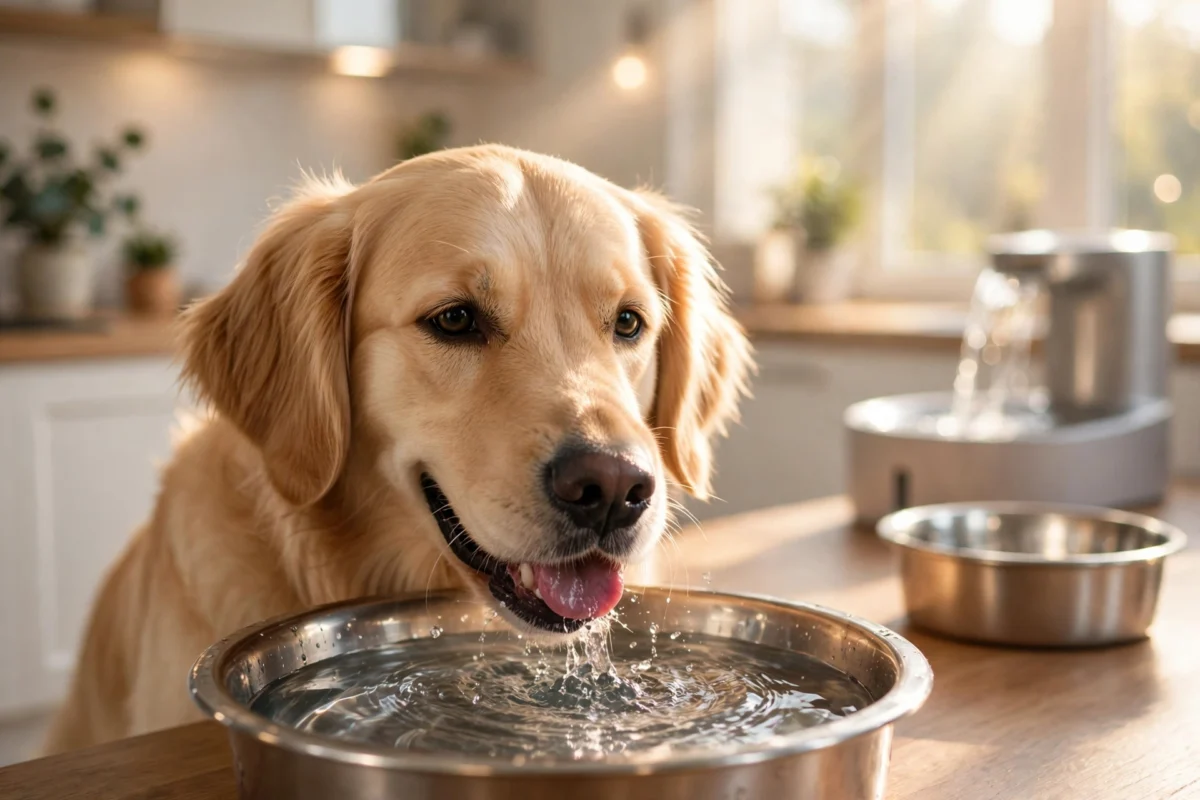
If you’re wondering how to get your dog to drink more water, you’re not alone — some dogs just don’t seem interested in their water bowl. The good news: most under-drinkers don’t need coaxing so much as a better setup. The fastest wins are simple: keep the water fresh and change it daily, put bowls in more than one spot, try a clean stainless steel bowl or a pet fountain, add moisture to meals with water or wet food, and flavor the water with a little low-sodium broth. As a rough benchmark, vets generally cite about 1 ounce of water per pound of body weight per day (PetMD), though activity, weather, diet, and age all shift that number.
Below are nine practical ways to get your dog to drink more water, plus how to tell roughly how much they need — and the one situation where you should skip the tricks and call your vet.
When to call your vet: These tips are for healthy dogs that are simply reluctant drinkers. If your dog suddenly drinks much less (or much more) than usual — especially with dry gums, weakness, lethargy, or vomiting — contact your vet promptly instead of trying tricks. (PetMD)
How Much Water Should a Dog Drink Per Day?
A widely cited veterinary guideline is about 1 ounce of water per pound of body weight per day — so a 20-pound dog lands around 20 ounces (PetMD; GoodRx, reviewed by a DVM). Veterinary internal-medicine specialists describe the same range as roughly 50–80 ml per kilogram per day, which works out to about the same thing (Whole Dog Journal).
Rough total daily water estimate — from drinking water plus moisture in food.
| Dog’s weight | Rough daily target |
|---|---|
| 10 lbs | ~10 oz (about 1¼ cups) |
| 25 lbs | ~25 oz (about 3⅛ cups) |
| 50 lbs | ~50 oz (about 6¼ cups) |
| 75 lbs | ~75 oz (about 9⅜ cups) |
Treat this as a starting estimate, not a prescription. Dogs that are very active, nursing, or living in hot weather typically need more, while dogs eating wet food get a lot of moisture from meals and may drink noticeably less from the bowl (PetMD; Chewy’s veterinary experts). Puppies fall in the “typically needs more” camp too — they’re growing and constantly moving — so treat the guideline as a rough starting estimate; needs vary by age, diet, activity, weather, and health. Ask your vet for a target that fits your puppy.
One rule that isn’t flexible: never restrict your dog’s water to “manage” intake unless your veterinarian specifically tells you to — water deprivation can cause dehydration and electrolyte problems (PetMD).
How to Get Your Dog to Drink More Water
Below is how to get your dog to drink more water, from the simplest daily habits to the tricks worth trying when the basics aren’t enough:
1. Change the water at least once a day
Dogs avoid stale water the way you’d avoid a glass that’s been sitting out overnight. Refresh the bowl daily at minimum, and wash the bowl itself with soap and water — biofilm (that slimy layer) builds up fast and puts dogs off (Chewy). If the bowl looks or smells off to you, your dog noticed before you did.
2. Put water in more than one spot
One bowl in one corner is easy to forget — for you and your dog. Place bowls in a few quiet, easy-to-reach spots around the house (and one outside in the shade if your dog spends time outdoors). Veterinarians recommend multiple stations partly because some dogs won’t drink where another pet guards the bowl, and partly because convenience works: water that’s right there gets drunk (Chewy).
3. Try a different bowl — or a fountain
Some dogs dislike plastic bowls, which can hold odors. Stainless steel is a favorite among vets because it sanitizes easily in the dishwasher; ceramic is another good option (Chewy, quoting Dr. Baker). For picky drinkers, a pet water fountain is worth trying: the moving water stays fresher and the sound itself attracts many dogs (Chewy, quoting Dr. Baker).
4. Add water to their kibble
The simplest answer to how to get your dog to drink more water costs nothing: pour a little water over dry food and let it soak for a few minutes. Start with a small amount and work up so the texture change doesn’t put your dog off their meal (Kristina Johansen, animal nutritionist; GoodRx).
5. Mix in some wet food
Canned food carries far more moisture than dry kibble, so even a partial switch — a scoop of wet food mixed into the regular meal — raises total fluid intake without your dog having to drink an extra drop (Chewy, quoting Dr. Casper). Just keep an eye on total calories, since you’re adding food on top of the regular meals.
6. Flavor the water with low-sodium broth
Safety first: use only plain low-sodium broth with no onion, garlic, or added spices — dogs and cats have developed toxicosis after ingesting onions and garlic in raw, cooked, or powdered form (Merck Veterinary Manual; Freshpet). A splash of low-sodium chicken or beef broth (or a spoonful of water from canned fish packed in water) makes plain water dramatically more interesting to most dogs (Kristina Johansen; Freshpet). You can also freeze broth into ice cubes and drop them in the water bowl for longer-lasting flavor.
7. Offer ice cubes
Some dogs enjoy ice in their water, especially in warm weather — and every cube is water. Drop a few cubes in the bowl rather than handing them out for chewing: crunching hard ice cubes can fracture a dog’s teeth (VCA Hospitals). If your dog ignores plain cubes, try dropping the frozen broth cubes from tip 6 into the bowl.
8. Bring water on walks and offer it after play
Dogs lose a lot of fluid panting, so the highest-value sips are the ones right after exercise. Carry a portable bottle or collapsible bowl and offer water during and after walks, hikes, and play sessions — many dogs that ignore the indoor bowl will drink eagerly when they’re warm and active (GoodRx; Kristina Johansen).
9. Reward drinking
It sounds simple, but praising or treating your dog right after they drink builds a habit — especially useful for puppies learning the routine (GoodRx). A quick “good drink!” plus a small treat a few times a day is enough.
How to Measure How Much Your Dog Actually Drinks
If you want a baseline before trying these tips, here’s a simple way to estimate your dog’s usual intake:
- Each morning, measure the water you add to the bowl with a measuring cup.
- After 24 hours, measure what’s left and subtract it from what you added.
- Repeat across several typical days and average the results.
Keep in mind that shared bowls and wet food make the estimate less precise — wet food contributes a lot of moisture. If your dog’s intake changes suddenly and you can’t explain why, ask your vet rather than relying on home measurements.
When to Call Your Vet Instead
Note: these tips are for healthy dogs that are simply reluctant drinkers. If your dog’s drinking habits change suddenly — drinking much more or much less than usual — or you notice other concerning signs alongside it, skip the tricks and call your veterinarian promptly (Chewy). A vet can determine what’s going on; this article can’t.
Frequently Asked Questions
How to get my dog to drink more water fast?
Start with the quickest wins: dump and refill the bowl with fresh water, add a splash of low-sodium broth (no onion or garlic), and offer water right after a walk or play session when your dog is warm. Longer-term, multiple water stations and a pet fountain keep intake up day to day.
How do I get my dog to drink more water if they only eat dry food?
Dogs on dry kibble need to get all their moisture from the bowl, so they’re the best candidates for these tricks. Add water to the kibble, mix in some wet food, and keep fresh water in several spots. Wet-food eaters naturally drink less from the bowl because their meals already contain so much moisture (PetMD).
How much water should a puppy drink?
Use the general guideline of about 1 ounce per pound of body weight per day as a rough starting point — puppies are growing, active, and lose water quickly, so their needs run higher, but the right target varies by age, diet, activity, and health. Ask your vet for one that fits your puppy.
Can I put anything in my dog’s water to make them drink?
A small amount of low-sodium chicken or beef broth is the most widely recommended option — just confirm it contains no onion, garlic, or heavy spices, which are unsafe for dogs (Freshpet). Skip sugary flavor enhancers and anything not made for pets.
Is it okay if my dog barely drinks but eats wet food?
Usually, yes — that’s expected. Wet food is mostly moisture, so dogs eating it simply need less bowl water (Chewy, quoting Dr. Casper). What matters is total fluid intake and that fresh water is always available. If bowl drinking drops suddenly with no diet change, check with your vet.
Sources
- PetMD — Why Is My Dog Drinking a Lot of Water? (veterinary-reviewed; 1 oz/lb guideline, never restrict water, puppies/active dogs need more)
- GoodRx Pet Health — How Much Water Should a Dog Drink in a Day? (DVM-reviewed; 1 oz/lb guideline with weight chart; encouragement tips including praise and walk bottles)
- Chewy — How To Get a Dog To Drink Water (veterinarian quotes: Dr. Berst on multiple bowls, Dr. Baker on stainless steel bowls and fountains, Dr. Casper on wet food)
- Chewy — How To Get Your Dog or Cat To Drink More Water (daily refresh, multiple stations, vet pointer for intake changes)
- Whole Dog Journal — How to Get a Sick Dog to Drink Water (internal-medicine specialist consensus: 50–80 ml/kg/day ≈ 1 oz/lb/day)
- Freshpet — How to Keep Your Dog Hydrated (ice cubes, low-sodium broth without onion/spices, multiple stations, daily bowl washing)
- Kristina Johansen, animal nutritionist — How Much Water Should My Dog Drink Daily? (6 encouragement methods: water stations, fresh water, broth flavoring, water in food, wet food, water on outings)
- VCA Hospitals — Dental Disease in Dogs (tooth fractures from chewing hard objects like ice cubes)
Leave a Reply