
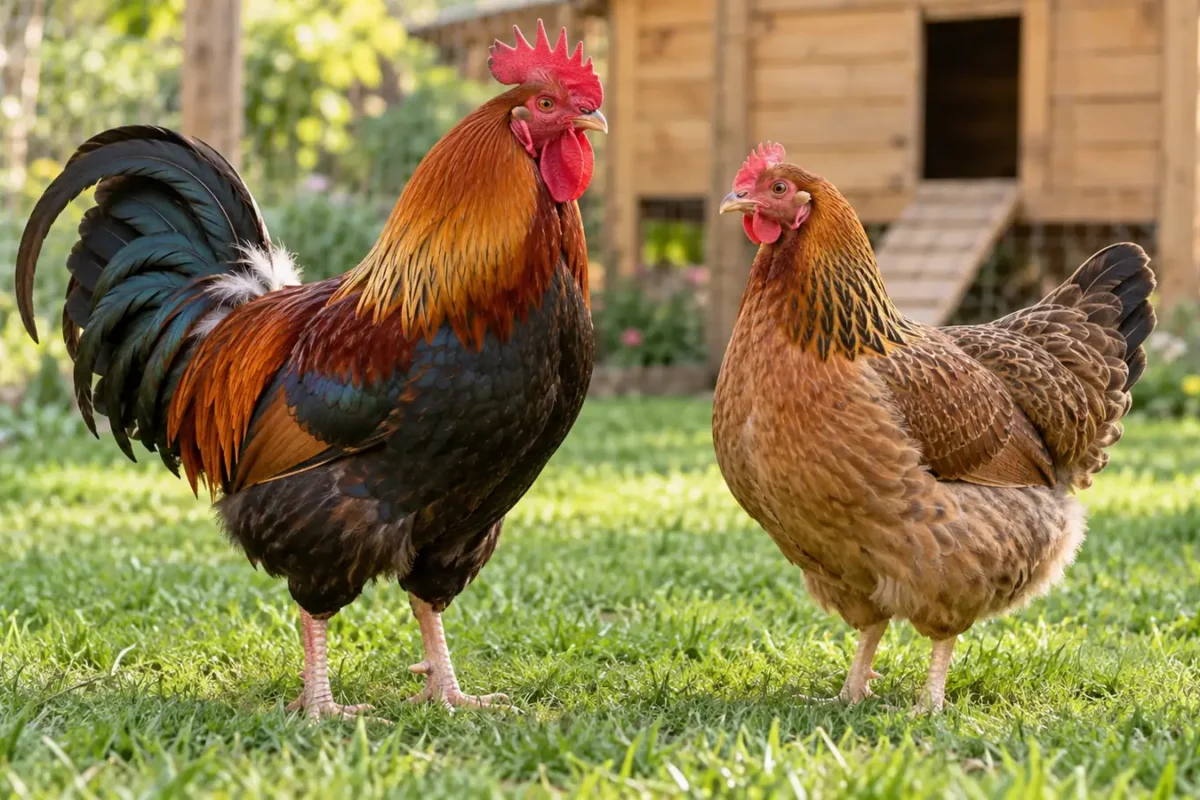
Wondering how to tell if a chicken is a rooster? Judge several traits together: an earlier, larger red comb and wattles; pointed hackle feathers around the neck; pointed saddle feathers in front of the tail; long curved sickle feathers; and regular crowing. Age and breed matter. At hatch, most chicks cannot be sexed accurately at home unless they come from a sex-linked or specially feather-sexable cross.
The safest approach is to compare birds of the same breed and age and wait for multiple signs. One thick leg, bold personality, or tall tail is not enough by itself.
Quick Rooster vs. Hen Checklist
| Feature | Rooster or cockerel | Hen or pullet | How reliable? |
|---|---|---|---|
| Comb and wattles | Often larger and redder earlier | Often smaller and paler until closer to laying age | Useful when comparing the same breed and age |
| Hackle feathers | Longer, narrower, and pointed | Shorter with rounded ends | Strong clue once adult feathering develops |
| Saddle feathers | Long, narrow, pointed feathers in front of the tail | Rounded feathers over the lower back | One of the clearest physical signs in most breeds |
| Tail feathers | May develop long, curved sickle feathers | Usually shorter and less curved | Helpful in mature birds; breed and molt affect appearance |
| Crowing | Regular crowing strongly suggests a male | Hens use many calls and can rarely produce crow-like sounds | Strong evidence, but use with physical traits |
| Egg laying | Does not lay eggs | An egg confirms the bird is female | Definitive when you know which bird laid it |
First, Know the Correct Age Terms
- Chick: a young chicken of either sex.
- Cockerel: a young male chicken, generally under one year.
- Pullet: a young female chicken, generally under one year.
- Rooster or cock: an adult male chicken.
- Hen: an adult female chicken.
People often ask whether a chick is a “rooster or chicken,” but both males and females are chickens. The practical comparison is cockerel versus pullet for young birds, or rooster versus hen for adults.
How Early Can You Tell If a Chick Is a Rooster?
At hatch: usually not by appearance
For most backyard breeds, a newly hatched male and female look alike. Mississippi State University Extension explains that vent sexing requires extensive training and that feather sexing works only when the necessary genetic traits are present in the strain.
Do not squeeze, invert, or probe a chick’s vent after watching an online demonstration. Incorrect vent sexing can injure the bird, and the method is difficult even for trained workers.
At 4–6 weeks: compare early development
Mississippi State notes that secondary sex characteristics can often begin helping small-flock owners after about four to six weeks. A cockerel may show a larger, redder comb and more visible wattles than same-age pullets. His head and body may also begin to look more angular or substantial.
These are clues, not proof. Comb type and growth rate vary by breed, and an early-maturing pullet can look more developed than a slow-maturing cockerel from another breed.
Around 10 weeks and beyond: feather shape becomes more useful
As juvenile birds grow, look for a pattern rather than one feature. An Extension poultry response notes that by about ten weeks some males show a more developed comb and wattles, pointed hackle and saddle feathers, spur development, and early crowing.
Exact timing varies. If the bird is still covered mainly in juvenile feathering, wait and compare again after the next stage of feather growth.
In adults: the differences are usually clearer
The University of Illinois Extension describes adult males as generally larger, with longer wattles and larger combs. Adult feather shape provides an even better check in most breeds.
The Most Reliable Physical Signs
Pointed hackle feathers
Hackle feathers grow around the neck. In most roosters they are long, narrow, and pointed at the tip. A hen’s hackles are usually shorter and rounded. Look at the actual feather edge in good light; a color pattern inside a rounded feather can create a false pointed appearance.
Pointed saddle feathers
Saddle feathers grow over the lower back just before the tail. Roosters develop narrow, pointed saddle feathers that drape toward the sides. Hens have rounder feathers in that area.
Penn State’s poultry biology guide identifies pointed male hackle and saddle feathers and rounded female feathers. It also notes an important exception: hen-feathered breeds such as Sebrights and Campines do not show the usual difference reliably.
Curved sickle tail feathers
A mature rooster often has long, glossy, curved feathers arching over the tail. These are called sickle feathers. They may be absent or incomplete in young birds, damaged feathers, molting birds, and some breeds, so a plain tail does not prove a bird is female.
Comb and wattle development
A cockerel’s comb and wattles often enlarge and redden earlier than a pullet’s. Compare flockmates with the same hatch date and breed. Do not compare a single-comb breed with a pea-comb, rose-comb, walnut-comb, or crested breed and expect the same shape.
Body shape and posture
Males often mature into a more upright stance with a broader chest and heavier-looking legs. This is a supporting clue only. Nutrition, health, breed, and individual growth can make a pullet larger or more upright than expected.
Behavioral Signs: Useful, but Not Enough Alone
Crowing
A repeated developing crow is strong evidence of a cockerel, even when the first attempts sound squeaky or incomplete. Do not wait for a perfect “cock-a-doodle-doo.” At the same time, identify which bird is actually making the sound before changing your flock plan.
Posturing and flock behavior
A young male may stand tall, watch for danger, spar with other birds, or begin courtship behavior. Pullets can also be assertive and establish rank. Temperament should support physical evidence, not replace it.
Spurs
Spurs are not an early yes-or-no test. Roosters commonly develop prominent spurs, but the growth can take time, and some hens also develop spurs. Look at hackle and saddle feather shape instead of using one leg bump as your verdict.
Sex-Link, Autosexing, and Feather-Sexable Chicks
Some hatchery chicks can be identified by color or feather growth at hatch because of planned genetics. Penn State explains that sex-linked hybrids show a visible difference between male and female chicks. Mississippi State cautions that wing-feather sexing also depends on specially selected fast- and slow-feathering traits.
This means the popular “spread the wing and compare feather lengths” test is not universal. It can work for the correct cross at the correct age, but it should not be applied to any random backyard chick.
| Method | When it can work | Main limitation |
|---|---|---|
| Color sexing | Sex-linked or autosexing breed/cross | Color rules depend on the exact genetics |
| Wing-feather sexing | Specific fast/slow-feathering crosses at hatch | Most breeds do not carry the required combination |
| Vent sexing | Performed by a trained professional | Difficult and potentially harmful when attempted casually |
| Secondary traits | As chicks grow, usually from several weeks onward | Timing and appearance vary by breed and individual |
Common Rooster-Sexing Myths
- “A chick with thick legs is always male.” Leg size varies with breed and growth.
- “A friendly chick is a hen; a bold chick is a rooster.” Temperament overlaps.
- “Every male has slow wing feathers.” Feather sexing requires specific genetics.
- “A spur means rooster.” Some hens grow spurs, and young males may not have visible ones yet.
- “A tall tail proves it.” Tail angle and feathering vary by breed, age, and molt.
- “No crow means hen.” A young or quiet cockerel may not have started crowing.
A Simple Age-by-Age Identification Plan
- At purchase or hatch: Record the breed, hatch date, and whether the hatchery sold the chick as sex-linked, feather-sexed, or straight run.
- At 4–6 weeks: Photograph each bird’s head and body. Compare comb color, wattle growth, and size only with same-age, same-breed chicks.
- From about 10 weeks: Recheck hackle and saddle feather shape as adult feathering starts to appear.
- As birds mature: Watch for sickle feathers, sustained crowing, courtship behavior, and egg laying.
- If the result matters urgently: Ask the hatchery, an experienced poultry breeder, Extension staff, or an avian veterinarian rather than relying on one photograph or test.
If roosters are restricted where you live, check the local ordinance before the bird matures. Rules may address number of birds, noise, setbacks, permits, or roosters specifically. Do not abandon an unwanted bird; contact the original breeder, local poultry groups, farm rescues, or lawful rehoming resources early.
Frequently Asked Questions
Can you tell if a chick is male or female by its wings?
Only in strains bred for feather sexing, and only when the feather-growth difference is expressed at the correct early age. The test is not reliable for most backyard chicks.
At what age do roosters start crowing?
There is no single age for every breed and individual. Some cockerels experiment while still young; others start later. Treat crowing as part of the evidence and confirm which bird made the sound.
Can hens have large combs and wattles?
Yes. Mature hens, especially in large-comb breeds, can have prominent red combs and wattles. Compare shape, timing, feather type, and behavior rather than using adult comb size alone.
Do all roosters have spurs?
Many adult roosters develop spurs, but development varies and young males may show little. Some hens also grow spurs, so this is not a stand-alone test.
Does a hen need a rooster to lay eggs?
No. Hens lay eggs without a rooster. A rooster is required only for fertilization, as Penn State Extension explains.
The Practical Answer
For most backyard chickens, the dependable answer comes with time. Start comparing comb and wattle development after several weeks, then look for pointed hackle and saddle feathers as adult plumage appears. Add tail shape, crowing, and behavior to the picture. The more independent signs agree, the more confident you can be that the bird is a cockerel or rooster.


Leave a Reply