
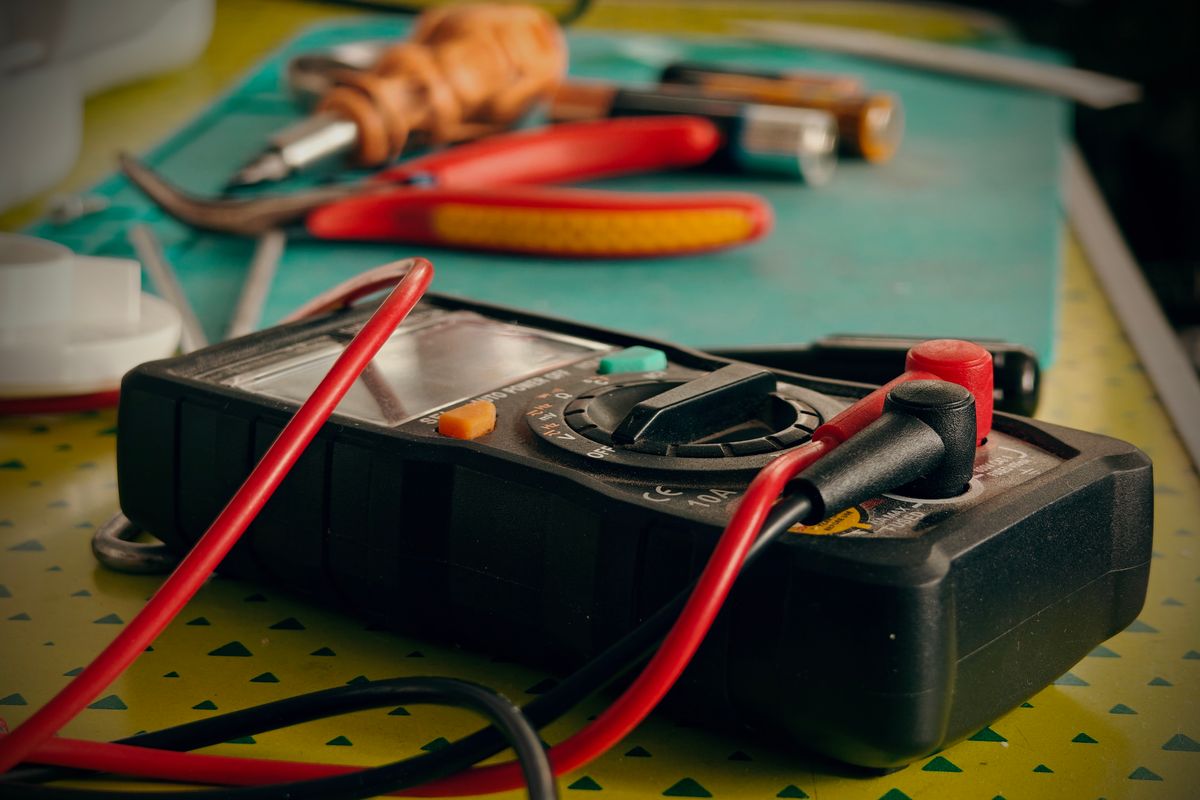
How to check a capacitor with a multimeter safely starts with one rule: do not touch or test it until the equipment is de-energized and any stored charge has been handled using the manufacturer-approved procedure. A capacitor can remain energized after power is off. If this is an HVAC unit, microwave, power supply, or other high-voltage equipment and you are not trained to work on it, stop and call a qualified technician. The steps below are limited to an isolated capacitor in a low-voltage project and must follow the capacitor and meter manufacturers’ instructions.
Quick answer: De-energize the equipment, verify it is de-energized, safely discharge the capacitor by the manufacturer-approved method, isolate at least one lead, select capacitance mode, measure across the terminals, and compare the reading with the printed rating and tolerance. Never touch a capacitor or test it while it is connected to power.
Before you test: know when to stop
Capacitors store energy. Fluke warns that a capacitor may remain charged after power is removed and recommends confirming power is off, discharging the capacitor, and verifying the discharge before measurement. In equipment with hazardous voltage, stored charge can cause severe shock even after unplugging. Do not open a microwave, air conditioner, furnace, or other high-voltage equipment just to run this test unless you are qualified and have the required safety procedure and tools.
Do not discharge a capacitor by shorting its terminals with a screwdriver or wire. That can create an arc, damage the part, or injure you. Use only the discharge method and rated equipment specified by the equipment or capacitor manufacturer. If you cannot identify the terminals, voltage rating, or safe procedure, stop and get professional help.
What you need
- A digital multimeter with a capacitance function and a rating suitable for the circuit.
- The equipment and capacitor manuals, including any stated tolerance.
- Insulated test leads in good condition and any personal protective equipment required by the equipment instructions.
- A safe, powered-off, isolated work area. Keep the capacitor away from other circuit components while measuring.
How to check a capacitor with a multimeter
- Turn off and isolate power. Follow the equipment’s shutdown and lockout instructions. Unplugging alone may not isolate every circuit. Do not proceed if you cannot verify the equipment is de-energized.
- Verify and discharge it safely. Use the manufacturer-approved method for the capacitor and confirm with a properly rated meter that the voltage has fallen to a safe level. Fluke’s guidance describes a resistor-based discharge method for the equipment it covers; the correct resistor and procedure depend on the capacitor and application. Never assume a capacitor is discharged because it has been sitting idle.
- Isolate the capacitor. Photograph or label the wiring before disconnecting anything. After confirming it is discharged, disconnect at least one terminal lead so the rest of the circuit does not affect the reading. If this involves fixed wiring or equipment you are not qualified to service, stop and use a technician.
- Set the meter to capacitance. Check the meter manual for the correct dial position and any function button. The display may show F, µF, nF, or a capacitor symbol. Confirm the meter’s range can measure the value printed on the capacitor.
- Connect the probes and wait. For a non-polarized capacitor, place one probe on each terminal. For a polarized capacitor, follow the meter manual and the markings on the component for polarity. Keep fingers behind the probe guards. Let the reading settle; small capacitors may take a moment.
- Compare the result with the label. Match units before comparing. A reading is within specification only if it falls inside the capacitor’s printed tolerance range. For example, a hypothetical 10 µF part marked ±10% would allow 9–11 µF; use the actual rating and tolerance printed on your component, not this example as a universal limit.
- Reconnect only after the test is complete. Confirm the capacitor is discharged again if the test setup could have charged it, then restore the wires exactly as documented. If the reading is outside tolerance, unstable, or the capacitor is physically damaged, replace it only with the correct type, capacitance, voltage rating, and safety classification—or have a qualified technician do it.
How to interpret the reading
A value inside the printed tolerance means the meter measured capacitance within that stated range under the test conditions. A value below or above it, an overload display, or a reading that will not settle can indicate a failed part, a measurement-range problem, or a setup issue. Recheck the meter manual and connections before drawing a conclusion.
A capacitance reading is not a complete health test. A basic multimeter may not reveal a capacitor that fails under operating voltage, has excessive leakage, or has another defect that only appears under load. A normal reading also does not prove that the rest of the equipment is safe or working correctly. Use the component’s service documentation for diagnosis.
What if the meter has no capacitance mode?
An ohms-mode “charging” movement may show that a capacitor responds to a small meter current, but it does not give a reliable capacitance value or a definitive pass/fail result. Results vary by meter, capacitance, and circuit condition. Do not treat a momentary change in resistance as proof that a high-voltage or HVAC capacitor is good. Use a suitable capacitance meter or consult a technician.
Common mistakes to avoid
- Measuring a capacitor while it is still connected to power or while it may hold a charge.
- Shorting terminals with a metal tool to discharge the component.
- Testing in-circuit and trusting a reading that may include other components.
- Comparing µF with nF without converting units, or ignoring the printed tolerance.
- Assuming a “good” capacitance number rules out every failure mode.
- Opening HVAC or microwave equipment without the training and protective procedures required for that equipment.
Frequently asked questions
Can a multimeter tell me if a capacitor is bad?
It can identify capacitance readings outside the component’s stated tolerance, but a basic capacitance test cannot detect every failure. Check the manufacturer’s diagnostic procedure and consider the circuit symptoms as well.
Can I test a capacitor without removing it?
An in-circuit reading can be inaccurate because other components affect the measurement. Fluke’s capacitance procedure calls for disconnecting the capacitor from the circuit. Only do this after safely de-energizing and discharging the equipment.
Is it safe to test an air-conditioner capacitor at home?
HVAC capacitors can retain hazardous charge and are part of equipment with dangerous voltage. If you are not trained to service that equipment, do not open it or attempt a test; contact a qualified HVAC technician.
Sources
- Fluke: How to Measure Capacitance with a Digital Multimeter
- Fluke digital multimeter manual: capacitance measurements and discharge warning
- Fluke: How to Use a Multimeter
Safety note: This guide does not replace the service manual, electrical-safety training, or advice from a qualified technician. Follow the instructions for your specific equipment and meter.
For a separate home-electrical topic, see our guide to outlets on a 15-amp circuit.

Leave a Reply