
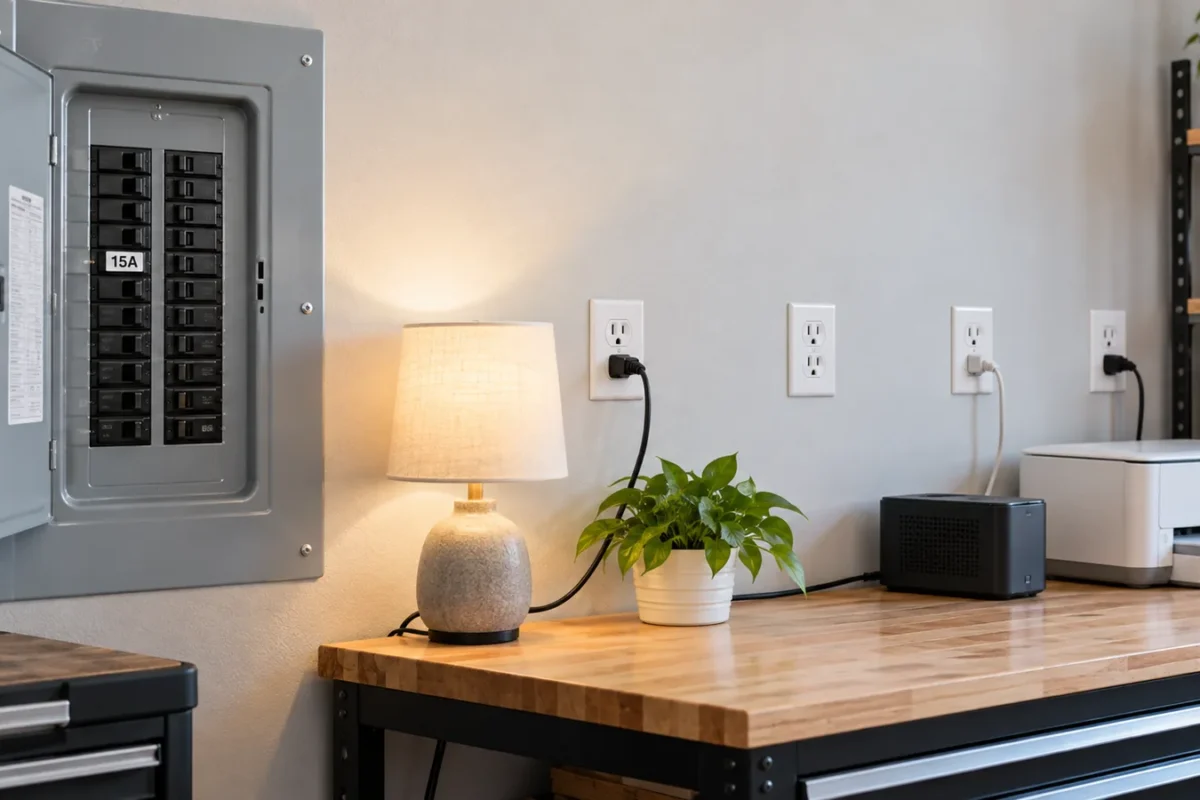
How many outlets can be on a 15-amp circuit? For a general-purpose circuit in a U.S. home, the National Electrical Code does not set one fixed maximum number of receptacles. The correct number depends on the loads that may run at the same time, whether any load is continuous, room-specific circuit rules, and the electrical code adopted where you live. Eight to ten receptacles can be a useful planning range for a lightly loaded room, but it is not a universal NEC limit.
The important distinction is between how many receptacles are installed and how much current the connected equipment draws. Ten phone chargers are very different from one space heater, even though the heater uses only one outlet.
Quick Answer: Outlet Count vs. Circuit Load
| Question | Practical answer |
|---|---|
| Does the NEC set a fixed maximum for general-purpose dwelling receptacles? | No single numeric cap applies to most general-purpose 15-amp dwelling circuits. |
| Is eight outlets the code limit? | No. Eight is a conservative planning shortcut, not a blanket dwelling-code maximum. |
| What actually limits the circuit? | Simultaneous load, continuous load, required dedicated circuits, conductor and breaker ratings, and local code. |
| What is the circuit’s theoretical capacity at 120 volts? | 1,800 volt-amperes: 15 A × 120 V. |
| What about a continuous load? | A continuous load must be included at 125% when sizing the branch-circuit overcurrent protection, subject to listed 100%-rated equipment exceptions. |
The NFPA committee material for NEC 210.23 says a 15- or 20-amp branch circuit may supply lighting outlets, lighting units, other utilization equipment, or a combination of them, while the connected load may not exceed the circuit rating. It also identifies exceptions for required kitchen small-appliance, laundry, and bathroom circuits.
Why You Hear “8 Outlets” or “10 Outlets”
Two common calculations produce those numbers, but neither should be presented as a universal residential rule.
The 180 VA calculation
NEC load calculations generally assign at least 180 volt-amperes to each single receptacle or each multiple receptacle on one yoke in the applications covered by the rule. The official NFPA material for 220.14(I) includes that 180 VA language.
Dividing 1,800 VA by 180 VA gives 10 receptacle yokes. That explains the widely repeated “10 outlets” answer. The catch is that dwelling-unit receptacle load calculations are handled differently in the NEC, so this math is not a general rule that limits every 15-amp circuit in a house to ten receptacles.
The “80% rule” calculation
Multiplying 15 amps by 80% gives 12 amps, or 1,440 watts at 120 volts. Dividing that by 180 VA gives eight. This is where the “eight outlets” answer often comes from.
However, the 80% figure is tied to continuous-load sizing. A continuous load is one expected to operate at maximum current for three hours or more. Under NEC 210.20(A) committee text, an overcurrent device must be sized for the noncontinuous load plus 125% of the continuous load, unless the listed 100%-rated equipment exception applies. It does not mean every mixture of short-duration household loads is automatically capped at 80%.
How Many Outlets Can Be on a 15-Amp Circuit in Practice?
For an ordinary bedroom, living room, office, or similar space, many designers keep the count around eight to ten receptacle yokes when the expected loads are light. Treat that as a planning choice, not code permission or a guarantee of capacity.
Plan from the equipment backward:
- List everything likely to run together. Use the wattage or amperage on each product label.
- Include lights on the circuit. A breaker may serve receptacles, lighting, or both unless a specific rule requires otherwise.
- Identify loads lasting three hours or more. These need continuous-load treatment.
- Allow for realistic future use. An unused receptacle today may later serve a heater, vacuum, printer, or power tool.
- Check local requirements. Your state or city may use an older NEC edition or local amendments.
The NEC itself becomes enforceable through state or local adoption. The Electrical Safety Foundation International’s NEC adoption guidance explains why the edition and amendments vary by jurisdiction.
Load Examples: Same Outlet Count, Very Different Results
| Example loads operating together | Total watts | Approximate current at 120 V | What it shows |
|---|---|---|---|
| Five 10 W LED lamps + 90 W laptop + 150 W television | 290 W | 2.4 A | Several used receptacles can still be a light load. |
| 1,500 W space heater | 1,500 W | 12.5 A | One appliance can use most of a 15 A circuit’s capacity. |
| 1,200 W vacuum + 300 W desktop computer + 60 W lighting | 1,560 W | 13 A | Short-duration loads can approach the breaker rating quickly. |
These are arithmetic examples, not instructions to load a circuit to those values. Appliance starting current, power factor, continuous operation, fixed equipment, wiring condition, and other connected loads can change the result. If a breaker trips, do not install a larger breaker as a workaround.
The U.S. Consumer Product Safety Commission’s home wiring guide recommends checking appliance labels, adding the watts on the affected branch, moving loads to a less-loaded circuit, and getting qualified help if an overload cannot be corrected.
Rooms Where a Simple Outlet Count Is the Wrong Question
Kitchens, bathrooms, and laundry areas
Required kitchen small-appliance, bathroom, and laundry branch circuits have their own rules and restrictions. These areas also commonly use high-draw appliances, so a general “eight outlets per circuit” shortcut is especially misleading.
Garages, basements, outdoors, and locations near water
Ground-fault protection requirements matter in wet and damp locations. ESFI’s current GFCI guidance lists bathrooms, garages, residential kitchens, basements, crawlspaces, laundry areas, outdoor receptacles, and receptacles near sinks among the locations where GFCI protection is required.
Bedrooms and living areas
Arc-fault protection is required in many dwelling areas under modern NEC editions. ESFI explains that AFCIs protect against dangerous arcing conditions associated with damaged wiring, stressed conductors, and loose or overheated connections.
Workshops and high-draw equipment
A workshop may have plenty of receptacles but insufficient capacity when a saw, compressor, vacuum, heater, or charger runs at the same time. Tool loads matter more than the wall-device count. The same planning principle applies whether you are setting up a workbench or choosing a drill bit for a 1/4-20 tap.
Receptacle Ratings and a Common 20-Amp Mistake
A 15-amp branch circuit should not have a 20-amp T-slot receptacle installed on it. Changing the receptacle or breaker does not increase the capacity of the conductors in the wall. The breaker, conductor size, receptacle rating, connected equipment, and installation method must work as one compliant system.
Do not replace a 15-amp breaker with a 20-amp breaker unless a qualified professional has verified that the entire circuit is designed and approved for 20 amps. An oversized breaker can allow conductors to overheat before the breaker opens.
Signs the Circuit Needs Attention
- The breaker trips repeatedly during normal use.
- A receptacle, plug, or faceplate feels unusually warm.
- You notice discoloration, melted plastic, buzzing, crackling, sparks, or a burning odor.
- Lights dim when another appliance starts.
- Plugs fit loosely or fall out of the receptacle.
- You depend on extension cords or power strips as permanent wiring.
Stop using any outlet that is hot, damaged, sparking, or producing a burning smell. Turn off the affected circuit if it is safe to do so and contact a licensed electrician. ESFI’s home electrical safety guidance recommends plugging major appliances directly into wall receptacles and treating heavy reliance on extension cords as a sign that additional professionally installed outlets may be needed.
When to Call an Electrician
Use a licensed electrician when you are adding a new circuit, changing breaker size, extending wiring, dealing with aluminum or damaged wiring, or working in a location that requires GFCI or AFCI protection. Also get professional help when the existing circuit cannot be identified confidently or when local permits and inspections apply.
Do not remove the service-panel cover or work on energized wiring to answer an outlet-count question. A load inventory and local code check can tell you whether the idea is plausible; an electrician can verify the conductor size, breaker, grounding, protection devices, box fill, and permit requirements.
Frequently Asked Questions
Is eight outlets the safe limit on a 15-amp circuit?
Eight is a conservative planning shortcut based on 1,440 watts and a 180 VA allowance. It is not a universal NEC maximum for dwelling receptacles. The expected simultaneous and continuous loads are more important than the raw count.
Does a duplex outlet count as one outlet or two?
In the 180 VA load-calculation rule, a single or multiple receptacle on one yoke is treated as one 180 VA outlet. A standard duplex receptacle on one yoke therefore is not automatically counted as two separate 180 VA outlets. That rule still should not be converted into a blanket dwelling receptacle cap.
Can lights and outlets share a 15-amp circuit?
General-purpose 15- and 20-amp circuits may supply lighting and receptacle loads together, but required kitchen, laundry, bathroom, appliance, and other dedicated circuits have separate restrictions. Local code and the intended loads decide whether sharing makes sense.
Can I put a 20-amp outlet on a 15-amp breaker?
No. A 20-amp T-slot receptacle should not be installed on a 15-amp branch circuit. Receptacle and breaker changes must match the conductors and the applicable code.
Why does my 15-amp breaker trip even with only a few outlets?
The breaker responds to current, not the number of wall plates. One or two high-wattage appliances may overload the circuit, or the trip may indicate a fault or failing device. Unplug loads and have recurring trips investigated rather than repeatedly resetting the breaker.
The Practical Answer
There is no single NEC number that answers every residential 15-amp outlet question. For an ordinary room, eight to ten receptacle yokes may be a sensible design range, but the defensible answer comes from the expected load, continuous-use rules, required room circuits, local amendments, and professional inspection. Count the watts and amps before counting wall plates.
Sources
- National Fire Protection Association: NFPA 70, National Electrical Code
- NFPA NEC committee report: permissible loads on multiple-outlet branch circuits
- NFPA NEC committee report: continuous and noncontinuous loads
- NFPA NEC committee report: receptacle load calculations
- U.S. Consumer Product Safety Commission: Guide to Home Wiring Hazards
- Electrical Safety Foundation International: NEC adoption
- Electrical Safety Foundation International: Home electrical safety

Leave a Reply