
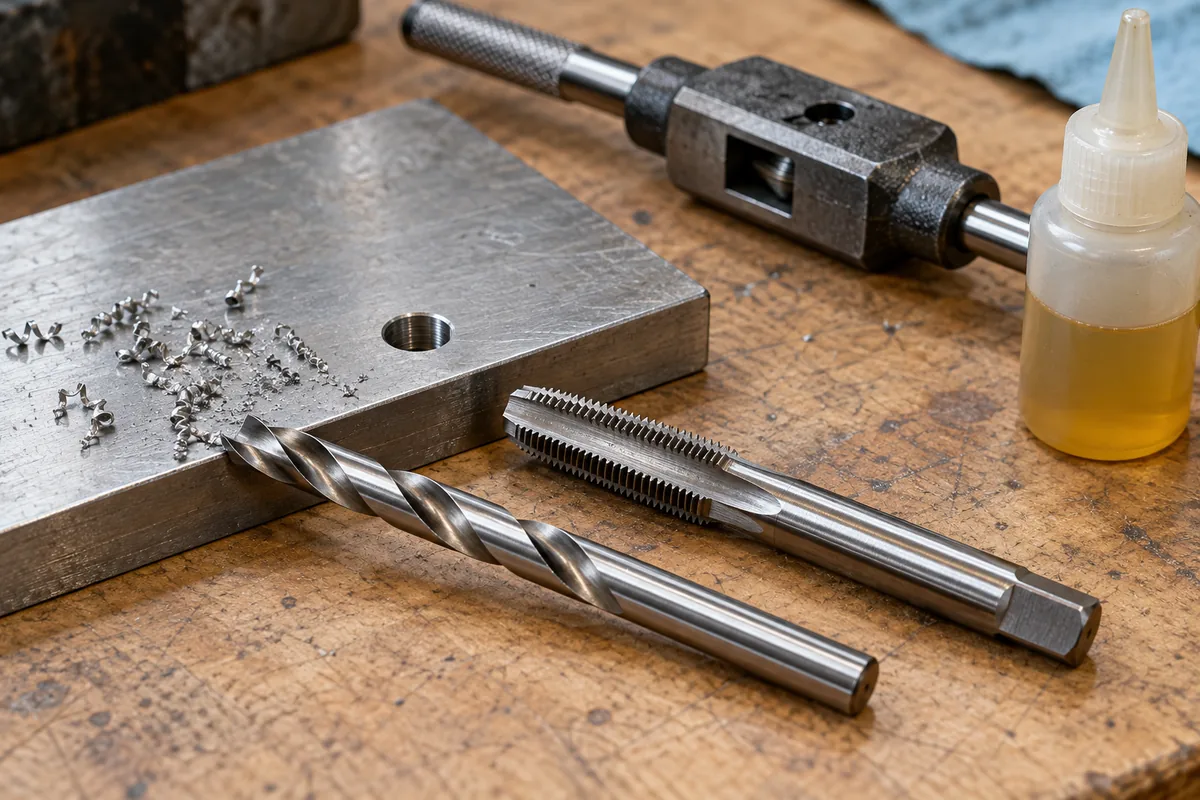
The correct drill bit for a 1/4-20 tap is a #7 drill bit, which measures 0.2010 inch (5.11 mm), before cutting a standard 1/4-20 UNC internal thread. A 5.1 mm bit is the closest metric choice. If your set contains only common fractional bits, 13/64 inch (0.2031 inch) is the closest practical substitute, but it produces a slightly larger pilot hole and slightly less thread engagement.
Milwaukee pairs a #7 drill with its 1/4-20 NC plug tap set, and Allied Machine lists Unified National tap-drill data in its manufacturer chart.
Drill bit for a 1/4-20 tap: quick size chart
| Item | Size | When to use it |
|---|---|---|
| Standard tap drill | #7 / 0.2010 in | Preferred for a 1/4-20 UNC cut tap |
| Closest metric | 5.1 mm / 0.2008 in | Near-direct metric replacement |
| Closest common fraction | 13/64 in / 0.2031 in | Usable when a #7 bit is unavailable |
| Fine-thread 1/4-28 tap drill | #3 / 0.2130 in | Only for 1/4-28 UNF, not 1/4-20 |
| Clearance hole for a 1/4-in bolt | Larger than tap drill | For a bolt to pass through without cutting threads |
Do not drill a 1/4-inch hole and expect a 1/4-20 cut tap to form useful threads. The pilot must be smaller than the bolt’s nominal 0.250-inch diameter so material remains for the tap to cut.
What does 1/4-20 mean?
The 1/4 is the nominal major diameter of the screw in inches. The 20 means 20 threads per inch. This is the common coarse Unified thread, written 1/4-20 UNC or sometimes 1/4-20 NC.
Do not confuse it with 1/4-28 UNF. The fine-thread tap has 28 threads per inch and uses a different pilot drill, commonly a #3. Read the marking on the tap before drilling.
Why the pilot hole is about 0.201 inch
A useful shop estimate for a 75% cut thread is:
tap drill diameter ≈ major diameter − thread pitch
For 1/4-20, the pitch is 1 ÷ 20, or 0.050 inch. Subtracting that from 0.250 inch gives 0.200 inch. The nearest standard number drill is #7 at 0.2010 inch.
The percentage is a practical balance. More thread engagement is not automatically better: an undersized hole makes the tap work harder and raises the chance of breaking it. A slightly larger hole is easier to tap but leaves shallower threads. For critical parts, follow the drawing, thread class, material guidance, and tap manufacturer’s recommended hole range rather than a general chart.
Is 13/64 inch close enough?
Yes for many ordinary shop and repair jobs. A 13/64-inch bit is 0.2031 inch, only 0.0021 inch larger than #7. The tap will cut a slightly shallower thread, which can make hand tapping easier in tougher material.
Avoid dropping to 3/16 inch. At 0.1875 inch it is substantially smaller, increases cutting load, and makes a broken tap more likely. A 7/32-inch bit at 0.2188 inch is too large for the usual 1/4-20 cut thread and removes too much material.
How to drill and tap a 1/4-20 hole
1. Confirm the tap type and required depth
These instructions are for a conventional cutting tap. Roll-form taps displace material instead of cutting it and normally require a larger pilot hole specified by the manufacturer.
For a blind hole, plan extra drill depth for the drill-point cone, tap lead, and chip space. Do not assume the full drilled depth becomes full thread.
2. Mark and secure the work
Use a center punch so the drill starts on location. Clamp the work securely. Wear eye protection, remove loose jewelry, and keep hair and clothing away from rotating equipment. Do not hold a small metal part in your hand while drilling.
3. Drill the pilot hole straight
Use the #7 bit with cutting fluid appropriate to the material. Keep the drill square to the surface. A drill press helps, but careful hand drilling can work for noncritical repairs.
Clear chips as needed rather than forcing a dull or packed drill. Deburr or lightly chamfer the top edge afterward; the chamfer helps the tap start and protects the first thread.
4. Start the tap square
Place the 1/4-20 tap in a tap wrench. Align it in both directions before applying pressure. The first turns establish the thread path, so correct a visible lean immediately.
Milwaukee specifies that its straight-flute hand taps are used with a tap handle and are not recommended for use with power tools. Hand control also makes it easier to feel rising resistance.
5. Cut gradually and manage chips
Apply cutting fluid. Turn forward with steady pressure, then back off periodically to break chips. The ideal rhythm depends on tap style and material; do not follow a fixed half-turn rule if the manufacturer gives different instructions.
For a blind hole, remove chips often and stop before the tap bottoms. A taper or plug tap starts easily; a bottoming tap can finish threads closer to the bottom after the first tap has established them.
6. Clean and test
Back the tap out, remove chips, and test with a clean 1/4-20 fastener. The bolt should start by hand. If it binds immediately, do not force it with a wrench; inspect for a crooked start, remaining chips, or the wrong thread pitch.
Material notes
- Aluminum: Use suitable lubricant and clear chips to reduce material buildup on the cutting edges.
- Mild steel: Cutting fluid and a sharp high-quality tap reduce effort.
- Stainless steel: It work-hardens easily; use the tap manufacturer’s hole recommendation, rigid alignment, and appropriate tooling.
- Cast iron: Manufacturer guidance may call for little or no fluid; control the abrasive chips.
Common mistakes
Choosing the bolt diameter as the drill size
A 1/4-inch drill makes a clearance-size hole, not the normal pilot for a 1/4-20 cut tap.
Mixing 1/4-20 and 1/4-28
The taps look similar but have different pitches and pilot sizes. Check the engraved marking.
Powering a hand tap with a drill
This removes feel and can snap the tap before you notice it binding. Use a proper tap wrench unless the tool is specifically made and set up for powered tapping.
Ignoring blind-hole depth
Drill depth, usable thread depth, and tap depth are different measurements. Leave room for the drill point, tap lead, and chips.
Frequently asked questions
What metric drill equals a #7 bit?
A 5.1 mm drill is the closest common metric size. It measures about 0.2008 inch.
Can I use a 13/64 bit for a 1/4-20 tap?
Yes for many noncritical jobs. It is slightly larger than #7, so the tap cuts slightly less thread. Use the specified size for engineered or high-load work.
What drill bit is used for a 1/4-28 tap?
A standard 1/4-28 UNF cut tap commonly uses a #3 drill, not #7.
What size hole lets a 1/4-inch bolt pass through?
That is a clearance-hole question, not a tap-drill question. The required size depends on whether the fit is close, normal, or loose; consult the drawing or clearance chart.
For more practical repair and maintenance guides, browse our Home Improvement section.

Leave a Reply