
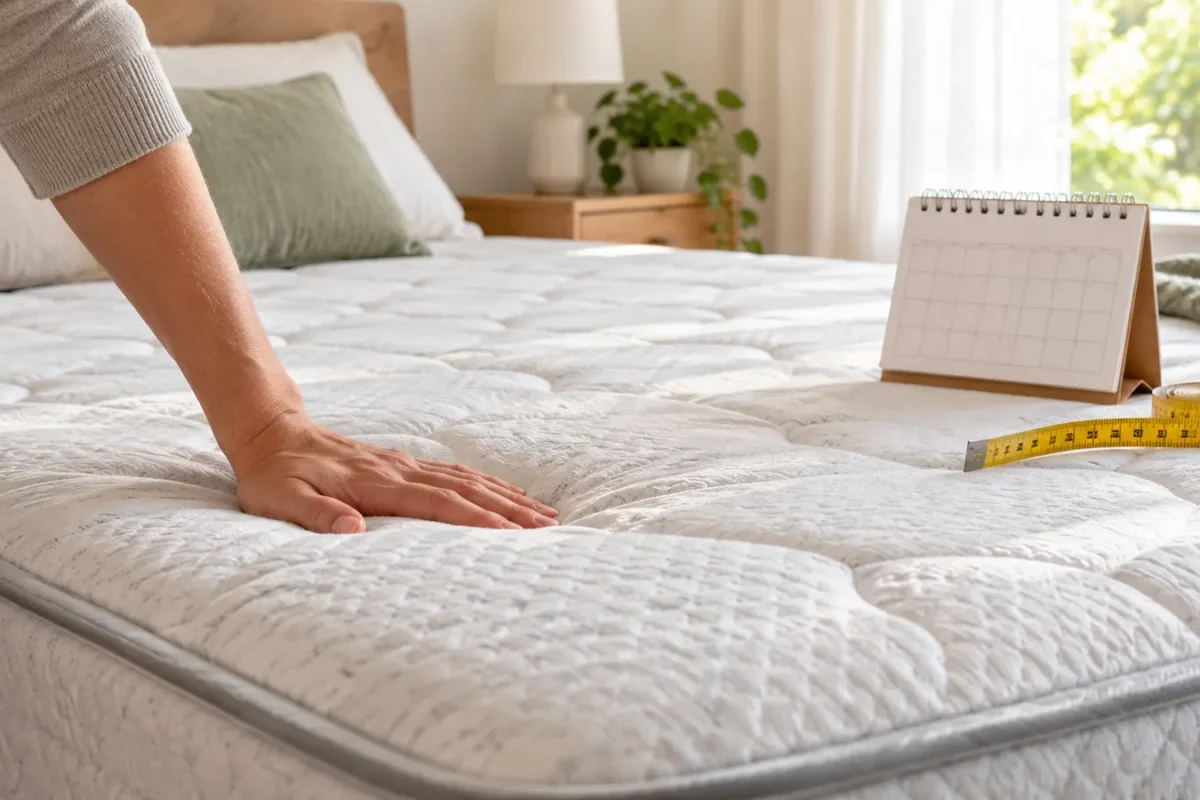
How long should you keep a mattress? Seven to ten years is a useful general range, but age alone should not decide it. Keep the mattress while it remains clean, supportive, comfortable, and free of meaningful sagging or damage. Replace it sooner if the materials have broken down or you consistently sleep better elsewhere.
The Better Sleep Council uses seven years as a practical checkpoint. Sleep Foundation gives a broader typical range of seven to ten years and stresses that construction, materials, use, and care all affect durability. Think of the calendar as a reminder to inspect the bed, not an automatic expiration date.
Quick Answer: Keep It or Replace It?
| What you find | Best next step |
|---|---|
| Under 7 years, comfortable, level, and supportive | Keep it and follow the maker’s care instructions. |
| About 7–10 years old with no clear problems | Inspect it closely and compare how you sleep at home with another supportive bed. |
| Visible sagging, deep impressions, broken coils, torn foam, or damaged edges | Check the warranty, foundation, and replacement options. |
| You regularly wake uncomfortable but sleep better elsewhere | Evaluate the mattress and base; age may not be the only cause. |
| Guest-room mattress with light use | Condition matters more than the purchase date. |
| Mattress is wet, moldy, heavily soiled, or infested | Stop using it and follow local disposal guidance rather than donating it. |
Why There Is No Single Mattress Expiration Date
Two mattresses bought on the same day can age very differently. One may be used every night by two adults; another may sit in a guest room. One may rest on the exact foundation required by its manufacturer; another may bow over widely spaced slats. Heat, moisture, spills, pets, children, body weight, material quality, and routine care all change how fast the layers wear.
The decision should combine three things:
- Age: Use seven years as a prompt to inspect, not a forced replacement date.
- Condition: Look for permanent impressions, loss of edge support, lumps, noise, or structural damage.
- Performance: Ask whether the mattress still provides the comfort and support you need.
Typical Mattress Lifespan by Type
Material categories help set expectations, but they do not predict the exact life of an individual bed. Sleep Foundation’s durability review reports average ranges around 5.5–6.5 years for innerspring mattresses, 6–7 years for all-foam models, 6.5–7.5 years for hybrids, and 7.5–8.5 years for latex. Quality varies widely inside every category, so use these as comparison ranges rather than guarantees.
| Mattress type | Common wear pattern | What to inspect |
|---|---|---|
| Innerspring | Coils and thin comfort layers may lose support | Sagging, noise, uneven firmness, weakened edges |
| All-foam | Foam can soften or hold body impressions | Permanent dips, slow recovery, reduced support |
| Hybrid | Foam layers and coil system can wear at different rates | Comfort-layer impressions, edge collapse, noise |
| Latex | Often durable, but quality and construction still matter | Soft spots, cracking, uneven support |
| Adjustable airbed | Mechanical and electronic parts add failure points | Air loss, pump problems, uneven firmness |
A mattress label such as “memory foam” or “hybrid” is not enough to estimate lifespan. Foam density, coil design, layer thickness, workmanship, and the support system under the bed all matter.
Seven Signs It May Be Time to Replace Your Mattress
1. The surface has permanent sagging or body impressions
Remove all bedding and inspect the mattress in good light. Look across the surface from the foot of the bed. A visible dip that remains when no one is lying on the mattress can show that materials have compressed or the support below is failing.
Before replacing the mattress, check the frame and foundation. A broken slat, weak center support, or incompatible base can create a sagging appearance. Manufacturer requirements differ, and an unsuitable base may also affect warranty coverage.
2. It feels uneven, lumpy, or softer in your usual spot
Move slowly across the surface with your hand and compare the center, edges, and each sleeping position. A familiar spot may soften so gradually that you notice the difference only when you use another part of the bed.
3. The edges no longer support you
If the perimeter collapses much more than it once did, getting in and out of bed can feel less stable and the usable sleep surface becomes smaller. Check whether the edge problem is limited to one area or affects the entire mattress.
4. Springs make new noises
Creaking can come from the mattress, frame, headboard, or foundation. Isolate the source before buying a new bed: tighten the frame, inspect slats, and test the mattress on the approved support system if the manufacturer permits it.
5. You consistently sleep better on another bed
The Better Sleep Council lists sleeping better at a hotel or someone else’s home as a sign worth considering. One good hotel night is not proof, but a repeated pattern suggests your current setup deserves a closer look.
6. Your comfort or support needs changed
A mattress can remain structurally sound while no longer fitting the people using it. A change in sleeping position, body size, mobility, or the number of sleepers may make a different firmness, height, edge design, or motion control more practical.
7. The mattress has damage you cannot clean or repair safely
Water damage, widespread mold, a severe pest problem, exposed coils, crumbling foam, or a torn cover that exposes internal material can make replacement the practical choice. Follow local disposal requirements and do not donate a wet, infested, or heavily soiled mattress.
Mattress Warranty vs. Mattress Lifespan
A 10-year or lifetime warranty does not promise that the mattress will feel like new for that entire period. A warranty is a written agreement covering specific defects under specific conditions. Normal softening, comfort preference, stains, damage, or an unsuitable foundation may be excluded.
The Federal Trade Commission recommends reading what a written warranty covers, what it excludes, how long coverage lasts, what the company will do, and how a claim must be filed. Before discarding a mattress:
- Find the receipt, law tag, model name, and warranty terms.
- Photograph the surface with all bedding removed.
- Measure any impression exactly as the manufacturer directs.
- Photograph the bed frame, slats, and center support.
- Contact the seller or manufacturer before moving or disposing of the mattress.
Do not assume that a visible dip automatically qualifies. The written policy determines the measurement method and coverage.
How to Check a Mattress in 10 Minutes
- Strip the bed. Remove sheets, pad, and protector.
- Inspect the top and sides. Look for dips, tears, shifting layers, or damage.
- Check the base. Inspect slats, center legs, foundation, and frame connections.
- Test several positions. Lie where you normally sleep, then compare the center and opposite side.
- Sit on each edge. Compare how evenly the perimeter supports you.
- Listen for noise. Move while someone checks whether the sound comes from the frame or mattress.
- Review the warranty. Do this before rotating, moving, repairing, or discarding the bed.
If the mattress is comfortable and level after the base is corrected, replacement may not be necessary. If the structure is failing, a topper may change surface feel but will not rebuild damaged support layers.
How to Help a Mattress Last Longer
- Use the foundation or slat spacing required by the manufacturer.
- Use a washable mattress protector to reduce spills and stains.
- Rotate the mattress only on the schedule the manufacturer recommends.
- Do not flip a one-sided mattress unless its instructions say it is flippable.
- Keep the mattress dry and address leaks or dampness quickly.
- Vacuum and spot-clean according to the care label.
- Support the mattress evenly when moving it; do not sharply fold a model that is not designed to bend.
Generic advice to rotate every three months does not fit every product. The owner’s manual or manufacturer care page should be the deciding source.
What to Do With an Old Mattress
Do not leave a mattress beside a dumpster or donate one that is wet, infested, heavily soiled, or structurally unsafe. Ask the retailer whether it offers take-back when delivering a new mattress, then check your city or waste hauler for bulky-item rules.
The Mattress Recycling Council’s Bye Bye Mattress directory lists participating recycling locations. Availability and fees depend on where you live, so confirm the facility’s current acceptance rules before transporting the mattress.
Frequently Asked Questions
Should you replace a mattress after seven years?
Seven years is a useful inspection point, not a mandatory deadline. Replace the mattress when its condition or performance has declined, or when it no longer meets your support and comfort needs.
Can a mattress last 15 or 20 years?
Some well-made mattresses with durable materials and light use can last longer than average. A long warranty or high price does not prove that yours will remain comfortable for 15 or 20 years. Inspect the actual bed rather than relying on the marketing term.
How long should a guest-room mattress last?
A lightly used guest mattress may last longer than one used nightly. Check for age-related material changes, moisture, pests, support problems, and guest comfort instead of applying a nightly-use timeline.
Does a mattress topper extend mattress life?
A topper can adjust surface feel and reduce some wear, but it cannot repair broken coils, failed foam, a sagging support core, or a damaged foundation. Treat it as a comfort layer, not a structural repair.
Should you replace the foundation at the same time?
Not automatically. Inspect it and compare it with the new mattress maker’s support requirements. Replace a damaged or incompatible base; keep a sound one only if it meets the specifications.
The Practical Answer
Most mattresses fall somewhere around the seven-to-ten-year range, but the right replacement date comes from the bed in front of you. Check its surface, base, edge support, comfort, care history, and warranty. If it remains clean, level, supportive, and comfortable, age alone is not a reason to throw it away.


Leave a Reply