
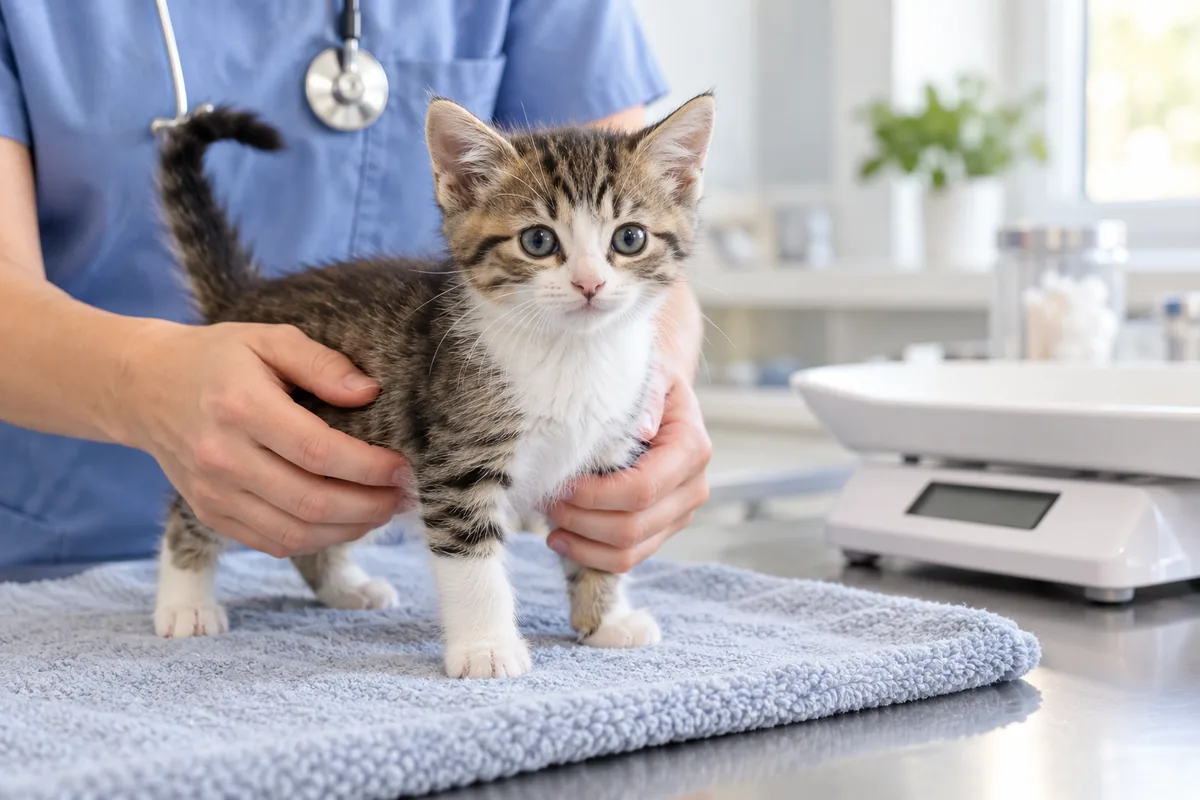
How to tell how old a kitten is: look at several clues together: whether the eyes and ears are open, how steadily the kitten walks, which teeth are present, and body weight. No single clue gives an exact birthday. Weight is most useful in a healthy young kitten, while teeth become more useful as permanent incisors begin appearing around 12 weeks.
ASPCApro’s kitten-age guide uses those same four checks. If the estimate will affect feeding, vaccination, deworming, or treatment, ask a veterinarian or shelter professional to examine the kitten rather than relying on an online chart alone.
How to tell how old a kitten is: age chart
| Approximate age | Eyes and ears | Movement and behavior | Teeth and typical weight clues |
|---|---|---|---|
| Newborn to 1 week | Eyes closed; ears folded | Crawls and depends completely on mother or caregiver | No teeth; commonly under 8 oz |
| 1–2 weeks | Eyes begin opening around days 8–12; fully open near 2 weeks | Crawling becomes stronger | No teeth or first tiny teeth near the end |
| 2–3 weeks | Eyes open; ears becoming upright | First wobbly steps | Baby incisors begin around 3 weeks |
| 3–4 weeks | Eyes open and usually blue | Walking improves; starts playing | More baby teeth; a healthy kitten may approach 1 lb |
| 4–5 weeks | Alert, ears upright | Runs, plays, and explores | Baby canines and premolars appearing |
| 6–8 weeks | Eye color may begin changing | Coordinated play; increasingly independent | Most baby teeth present; around 2 lb near 8 weeks in good condition |
| 8–12 weeks | Adult eye color clearer | Fast, coordinated, highly playful | Full baby-tooth set; weight varies with build and health |
| 12–16 weeks | Adult appearance developing | Confident movement | Permanent middle incisors around 12 weeks; more incisors follow near 14–16 weeks |
The ranges overlap. A small-breed kitten, an underfed kitten, or one recovering from illness may weigh much less than the age rule suggests.
Check 1: Are the eyes open?
Kittens are born with their eyes closed. ASPCApro says the eyes usually begin opening at 8 to 12 days and are fully open by about 2 weeks. Both eyes may not open on the same day.
Do not force an eyelid open. Discharge, swelling, cloudiness, or an eye that remains sealed while the other is open needs professional attention.
Young kittens commonly have blue-looking eyes. The color begins changing later, so blue eyes by themselves do not prove a kitten is only a few weeks old. Some adult cats naturally keep blue eyes.
Check 2: Look at the ears
Newborn ears sit folded close to the head. They gradually unfold and become more upright over the first few weeks. By about 3 weeks, the ears usually look noticeably more erect and responsive to sound.
Ear position is a supporting clue rather than a precise clock. Breed, individual development, and the kitten’s posture can change how upright the ears appear in a photo.
Check 3: Watch how the kitten moves
Most kittens start walking around 3 weeks, according to ASPCApro. Early steps are wide, slow, and wobbly. By 4 weeks, a kitten that is healthy is usually walking more steadily and beginning to play.
From roughly 5 to 8 weeks, coordination improves quickly. The kitten can run, pounce, climb low objects, and play with littermates. A lack of coordination in an older-looking kitten is not a reason to simply label it younger; weakness or illness can also affect movement.
Check 4: Weigh the kitten carefully
For a kitten in good body condition, ASPCApro offers a simple early estimate:
- about 1 pound may indicate roughly 4 weeks;
- about 2 pounds may indicate roughly 8 weeks; and
- about 2.5 pounds may indicate roughly 10 weeks.
Use a kitchen or pet scale that reads small increments, place a towel or shallow container on it, zero the scale, and keep one hand close so the kitten cannot fall. Record weight in ounces or grams.
The ASPCA kitten chart notes that weight should be combined with developmental milestones. Genetics, litter size, nutrition, parasites, and illness can all change growth.
Check 5: Use the teeth for a closer estimate
Teeth are especially helpful from about 3 weeks onward. Handle gently and stop if the kitten resists; a veterinarian can examine the mouth safely.
Baby teeth
Baby incisors begin appearing around 3 weeks. Canines and premolars follow, and most kittens have their complete set of tiny deciduous teeth by about 6 to 8 weeks.
Permanent teeth
ASPCApro says the first permanent teeth—the middle incisors—appear around 12 weeks. The next incisors follow at approximately 14 and 16 weeks. Baby teeth are smaller and more pointed; permanent incisors are wider and flatter at the edge.
The organization’s aging-kittens dental guide is most useful between about 12 and 24 weeks, when baby and adult teeth can be compared in the same mouth.
A practical week-by-week check
Under 2 weeks
Eyes are closed or only partly open, ears remain low, and the kitten mostly crawls. This age needs specialized neonatal care. If the mother is absent, contact a veterinarian or local rescue promptly for feeding and temperature guidance.
Around 3 weeks
Eyes are open, ears are lifting, the first incisors may be visible, and the kitten attempts wobbly walking.
Around 4 weeks
The kitten walks and plays more confidently. A healthy kitten may be close to 1 pound, but use weight as a cross-check rather than a verdict.
Around 5 to 6 weeks
Running, pouncing, and grooming look more coordinated. More baby teeth are present, and eye color may start to shift away from kitten blue.
Around 7 to 8 weeks
Most baby teeth are in. The kitten is active and coordinated; a healthy kitten often weighs around 2 pounds. Alley Cat Allies’ kitten progression guide shows the physical and behavior changes through these early weeks.
Around 3 to 4 months
Permanent incisors start replacing baby teeth. Body proportions look less round and baby-like, but dental development is more useful than appearance alone.
Why the clues sometimes disagree
A kitten may have the teeth of one age and the weight of a younger kitten. That does not make the chart wrong; it means weight was affected by body size, nutrition, or health. Prioritize the more age-specific milestones, especially tooth eruption, and ask a professional when the difference is large.
Avoid estimating from coat color, sex, or personality. A shy kitten is not necessarily younger, and a bold kitten is not necessarily older.
What to do after estimating the age
Write down the estimated range rather than inventing an exact birth date: for example, “about 5 to 6 weeks.” Share the clues you used with the veterinarian or rescue.
Age affects appropriate food, warmth, socialization, and preventive care. This article helps with observation; it does not replace a care plan. Do not give medication or use flea products based only on a home age estimate.
For another transparent age-estimation example, see our guide to a 4-month-old dog in human years, which also explains the limits of age shortcuts.
Frequently asked questions
Can you tell a kitten’s age by weight alone?
No. The one-pound-per-month shortcut can be useful in healthy kittens through the first couple of months, but illness, nutrition, and natural body size can shift weight substantially.
When do kittens open their eyes?
The eyes usually begin opening at 8 to 12 days and are fully open by about 2 weeks. Never force them open.
When do kittens start walking?
Most start around 3 weeks. By 4 weeks, healthy kittens generally walk better and begin active play.
When do kittens get teeth?
Baby teeth begin around 3 weeks. Permanent middle incisors start appearing near 12 weeks, with additional incisors around 14 and 16 weeks.
How accurate is a kitten age estimate?
For a very young kitten, combining eyes, ears, movement, weight, and teeth can narrow the estimate to a useful range. Exact birth dates usually remain unknown without a history.



Leave a Reply