
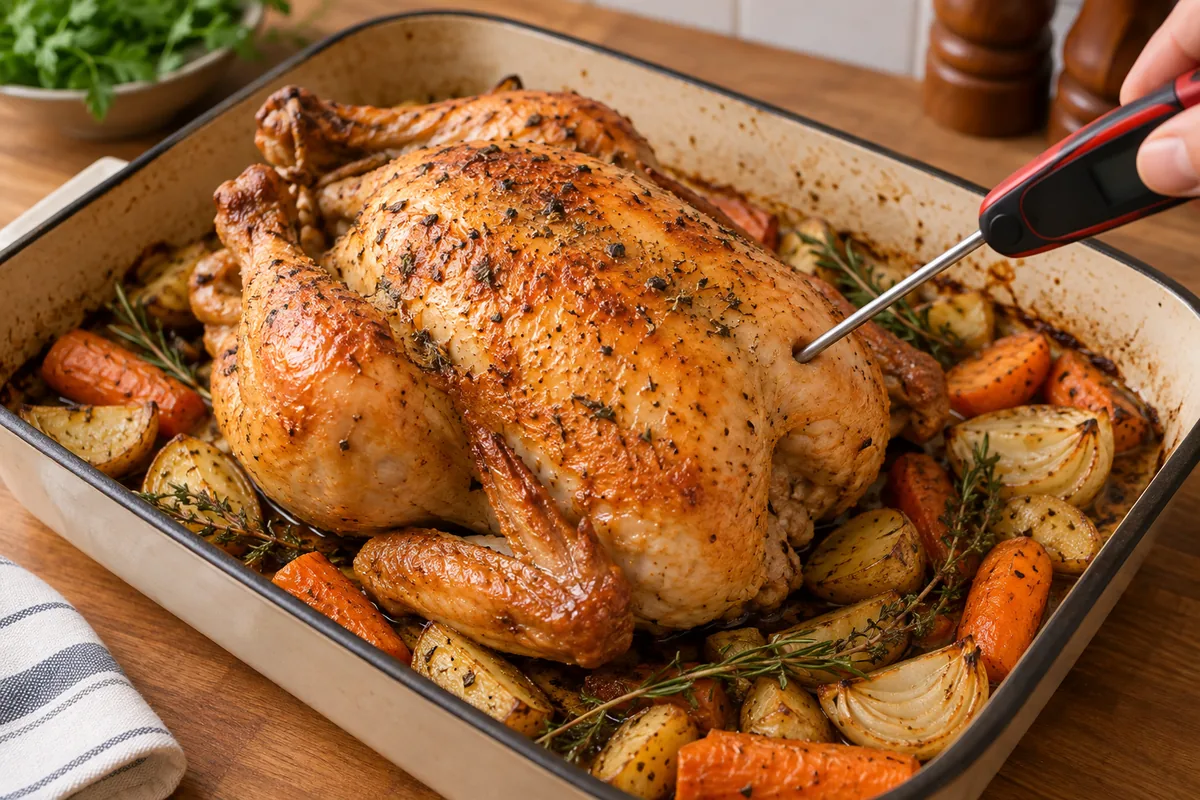
How long to bake a whole chicken in the oven depends mainly on its weight. Bake an unstuffed 3-to-4-pound whole chicken at 350°F for about 1¼ to 1½ hours. A 5-to-7-pound roasting hen generally needs 2 to 2¼ hours. Treat those times as planning ranges and use a food thermometer for the final decision: the breast, inner thigh, and inner wing should each reach 165°F.
Those ranges come from the USDA whole-chicken cooking chart. Weight helps estimate dinner time, but shape, starting temperature, pan, and oven accuracy can all change the finish time.
How long to bake a whole chicken in the oven at 350°F
| Chicken | Approximate weight | USDA planning time at 350°F |
|---|---|---|
| Broiler-fryer, unstuffed | 3–4 lb | 1¼–1½ hours |
| Roasting hen, unstuffed | 5–7 lb | 2–2¼ hours |
| Capon, unstuffed | 4–8 lb | 2–3 hours |
| Cornish hen | 18–24 oz | 50–60 minutes |
If the cavity is stuffed, the USDA chart says to allow roughly 15 to 30 additional minutes. The center of the stuffing must also reach 165°F. Cooking stuffing separately is easier to time and gives hot air more room to circulate inside the bird.
The reliable method: time plus temperature
1. Heat the oven to 350°F
Place a rack in the lower-middle portion of the oven so the chicken sits near the center. If your oven runs hot or cold, an oven thermometer can explain why your timing differs from a chart.
2. Prepare the chicken without washing it
Remove the chicken from its packaging and take the giblet packet out of the cavity if one is present. Pat the surface dry with paper towels. The USDA advises against washing raw poultry because splashing water can spread bacteria around the sink and counter.
Rub the skin lightly with oil and season inside and out. Tuck the wing tips behind the bird if possible. Tie the legs loosely only if you want a compact shape; binding them very tightly can slow heat from reaching the thigh area.
3. Roast breast-side up
Set the chicken breast-side up on a rack in a shallow roasting pan or in an oven-safe skillet. Leave it uncovered so the skin can brown. Start checking before the low end of the expected range, especially for a small bird.
Avoid opening the oven repeatedly. Each long door opening drops the oven temperature and makes a time chart less useful.
4. Check three places for 165°F
Insert an instant-read thermometer into:
- the thickest part of the breast;
- the innermost part of the thigh; and
- the innermost part of the wing.
Keep the probe away from bone, which can distort the reading. The USDA safe-temperature chart sets 165°F as the safe minimum for whole poultry and for stuffing.
If one location is below 165°F, return the chicken to the oven and check again after a short interval. Clear juices and loose legs can be clues, but neither replaces a thermometer.
5. Rest before carving
Let the chicken rest for about 10 to 15 minutes. Resting makes it easier to carve and gives the juices time to settle. The bird still needed to reach 165°F before it left the oven; resting is not a substitute for the temperature check.
How long per pound does a whole chicken take?
Per-pound formulas are rough because cooking does not scale in a perfectly straight line. The USDA weight bands above are more dependable for planning. If you need a starting estimate, many home roasting methods land around 20 minutes per pound at 350°F, plus checking time, but the thermometer—not the formula—decides when dinner is ready.
For example, a compact 4-pound bird and a long, lean 4-pound bird may finish at different times even though the scale reads the same.
What about roasting at 375°F, 400°F, or 425°F?
A hotter oven can brown the skin faster and shorten the cook, but exact time depends heavily on the recipe and bird size. If you change temperature, keep the same safety endpoint: 165°F in all three USDA check locations.
For a predictable first attempt, the USDA’s 350°F chart gives a clear baseline. Use a hotter recipe only when it supplies its own time range and pan directions.
How to get crisp skin without drying the breast
- Pat the skin dry before seasoning.
- Use a shallow pan rather than a deep covered pot.
- Do not pour a large amount of liquid over the skin.
- Begin checking temperature early instead of adding an automatic extra 20 minutes.
- Let the chicken rest uncovered; tenting tightly can soften the skin.
If the skin browns too quickly before the meat reaches 165°F, loosely shield the dark area with foil.
Can you roast a frozen whole chicken?
The USDA says poultry can be cooked from frozen in an oven, but it may take about 50% longer than a fully thawed bird. The giblet packet can be difficult to remove while frozen, and uneven shape makes timing less predictable. Thawing in the refrigerator is the easier option.
Allow about 24 hours of refrigerator thawing for each 4 to 5 pounds of whole chicken. Cold-water thawing is faster but requires a leakproof package, frequent water changes, and immediate cooking. Never thaw poultry on the counter.
Leftovers and make-ahead safety
Refrigerate carved chicken within 2 hours, or within 1 hour when the surrounding temperature is above 90°F. Store it in shallow covered containers and use it within 3 to 4 days. The same cold-storage principles apply to beef — see how long steak can sit in the fridge. Reheat leftovers to 165°F.
Leftover breast and thigh meat can be shredded for the methods in our guide to cooking chicken for buffalo chicken dip.
Frequently asked questions
How long does a 4-pound chicken take at 350°F?
Plan on about 1¼ to 1½ hours for an unstuffed 3-to-4-pound broiler-fryer, then verify 165°F in the breast, inner thigh, and inner wing.
Is a whole chicken done at 160°F or 165°F?
USDA consumer guidance calls for 165°F. Check several locations because a breast reading does not prove the thigh and wing area are also ready.
Should I cover a whole chicken with foil?
Roast it uncovered for browning. If one area becomes too dark before the chicken is done, shield that area loosely with foil.
Does stuffing change the cooking time?
Yes. The USDA chart adds about 15 to 30 minutes for a stuffed chicken, and the center of the stuffing must reach 165°F. Separate stuffing is simpler and more predictable.
Can I trust the pop-up timer?
Use an instant-read thermometer even if the bird has a pop-up device. You need readings in multiple parts of the chicken.
Leave a Reply